
Clear office glass keeps views open. Frosted glass obscures them, either across a selected area or over the whole panel. The right choice depends on what you need to keep private and where people can see into the room. A band may screen a seated conversation while leaving a monitor visible below it.
When comparing frosted vs clear office glass partitions, start with the furniture, screens and views from the corridor. Then choose the coverage and finish. Frosting can soften views while allowing light through, but full coverage does not automatically mean complete concealment.
You can combine clear and frosted panels within the same office, giving each room the privacy it needs.
What Do You Need to Keep Private? nference Room?
Identify what someone passing the room should be unable to see: a computer screen, documents on a desk, a whiteboard or the people seated inside. Each may need coverage at a different height.
Walk the routes used by staff and visitors. Look into the room from the corridor, reception seating and nearby desks. Include angled views through adjoining panels, particularly where the glass turns a corner.
For conference rooms, use the planned seating and presentation positions. A band that screens people around the table may leave a wall display exposed above it.
Write down the specific result you need. “Hide the reception monitor from the waiting area” gives you a clearer basis for choosing a finish than “add some privacy.” It also helps you avoid covering glass that could remain clear.
Compare Your Office Glass Privacy Options
Clear glass preserves direct views. A frosted band screens a selected zone. Full frosting obscures detail across the panel, while gradients and patterns provide varying coverage.
Coverage and opacity are separate choices. Coverage describes where the treatment goes; opacity describes how much it obscures. A full panel with a light frost may reveal more than a smaller area with a denser treatment.
| Option | What It Does | When It May Fit | What to Check |
|---|---|---|---|
| Clear glass | Preserves direct views through the partition | Collaboration areas and rooms where visibility is useful | Whether screens, documents or occupants need screening |
| Frosted privacy band | Obscures a horizontal area while leaving clear glass above and below | Rooms where a defined zone needs privacy | Views over, under and around the band |
| Full frosted coverage | Obscures detail across the treated panel | Rooms needing broader visual screening | Whether silhouettes, movement or screen content remain visible |
| Gradient or patterned treatment | Varies the amount of screening across the glass | Rooms needing selective coverage or a decorative finish | Whether clear sections expose anything sensitive |
A frosted finish can transmit and diffuse light, but different products admit different amounts. Compare samples for both visibility and brightness rather than assuming every white or matte finish performs alike.
How High Should a Glass Partition Privacy Band Be?
A glass partition privacy band should cover the views you need to interrupt. There is no single height that screens every desk, chair and standing position.
Start with the furniture arrangement, then identify the upper and lower limits of the area that needs coverage. A narrow strip at standing eye level can leave seated occupants and laptops visible beneath it.
| Viewing Position | What Needs Screening | Coverage to Review | What the Sample Should Demonstrate |
|---|---|---|---|
| Standing in the corridor | Seated faces and desktop monitors | A band covering the relevant viewing angles | Faces and screen details are sufficiently obscured |
| Seated in a waiting area | Lower screens, paperwork and people across the room | Coverage extending lower on the panel | The view beneath the proposed band is acceptable |
| Passing a corner or doorway | Side views of desks and displays | Coverage continuing onto the relevant adjoining panels | Sensitive content stays screened from angled views |
| Looking toward a presentation wall | Whiteboard notes or displayed information | Taller or fuller coverage where needed | Content cannot be read through clear sections |
If several desks sit at different heights, one continuous band may need to be wider than expected. Moving or turning a monitor can sometimes resolve an exposed view without adding more frosting.
Privacy Film or Permanently Frosted Glass?
Applied film offers more flexibility for later changes. Permanently finished glass suits a treatment intended to remain part of the room. Compare the appearance, care requirements and future replacement work alongside the initial price.
Privacy Film for Office Glass
Privacy film is applied to the glass surface and is available in frosted, patterned and gradient designs. On suitable existing clear glass, it can change the coverage without replacing the panel.
This can suit an office where seating, branding or room use may change. A wider band or different pattern may be possible later, subject to the product and glass surface.
Removal still involves work. Adhesive residue can remain, and the film’s age, condition and compatibility with the surface affect the process. Include removal and preparation when comparing future changes.
Acid-Etched and Sandblasted Glass
Acid etching and sandblasting alter the glass surface to create a frosted effect. They are different processes, so compare their samples and care instructions separately.
These finishes cannot be peeled away like applied film. Returning a permanently frosted panel to clear glass generally means replacing it. They are worth considering when the coverage is unlikely to change and you prefer the finish to be part of the panel itself.
Patterned and Fluted Glass
Patterned or fluted glass can distort views while adding texture. The level of screening varies, so evaluate it against the same privacy requirements as a plain frost. A textured appearance alone does not establish that documents or screen content will be hidden.
With either framed or frameless partitions, review where the treatment meets frames, panel joints and door edges. Those details affect how continuous the coverage looks across the wall.
Will Frosted Glass Hide Screens and Silhouettes?
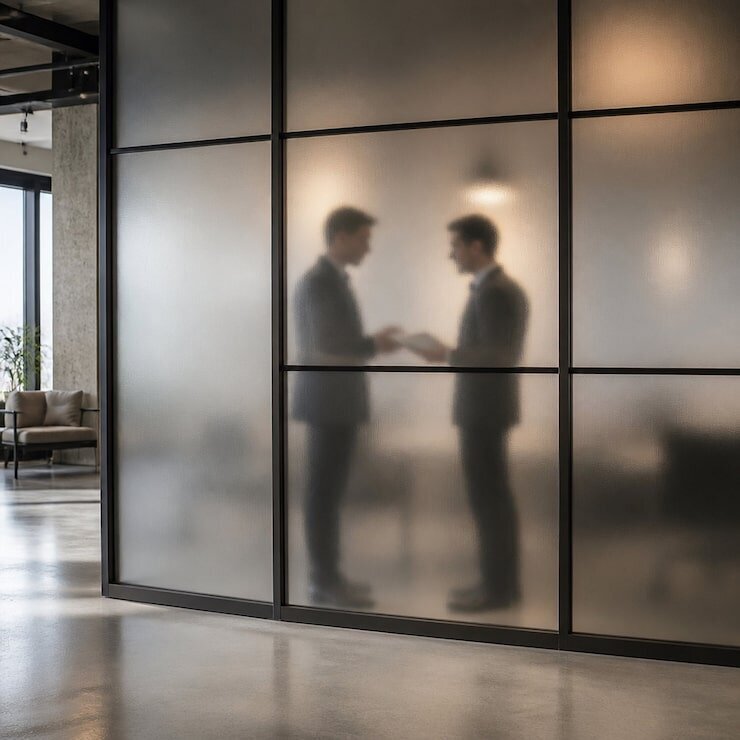
Frosted glass can obscure detail while still revealing shapes and movement. Whether a screen remains readable depends on the finish, viewing angle, lighting and distance between the screen and the glass.
Test a representative sample in the proposed room. A small swatch helps you compare appearance, but a larger sample or mock-up is more useful for checking coverage across a desk or seated person.
During the review:
- Put a monitor in its planned position and display typical content.
- View it from the corridor and any nearby seating.
- Check a person seated at the desk and standing close to the glass.
- Repeat under daylight and the electric lighting used after dark.
- Look through adjoining panels and around the edges of the treatment.
For sliding or hinged glass doors, check what becomes visible as the door moves and when it is open. Frosting on the door cannot screen an open doorway.
Visual screening also does not establish speech privacy. If conversations need to remain confidential, assess sound control separately from the glass finish.
How Will Cleaning and Future Changes Affect Your Choice?
Choose a finish your cleaning team can maintain using its manufacturer’s instructions. Applied film, etched glass and textured surfaces can have different requirements; one cleaning routine may not suit every panel.
For film, retain the instructions covering when cleaning can begin, suitable products and care around edges. For permanently finished glass, keep the guidance for the specific surface rather than assuming any standard glass cleaner is suitable.
Think about the next office change, too. A new desk position can expose a screen that the original band concealed. A room changing from an open meeting space to a private office may need broader coverage.
If a room requires a fully concealed wall or a surface for storage and displays, a layout combining glass and drywall may fit better than treating every panel.
What Should Your Privacy Glass Quote Include?
Your quote should describe the treatment precisely enough to compare it with another proposal. “Frosted glass” leaves too much open: it could mean applied film, a permanent finish, a narrow band or full coverage.
Include:
- The finish: Applied film, etched glass or another specified treatment.
- The coverage: Which panels and doors are treated, including band dimensions or pattern placement.
- The appearance: An agreed sample or identifiable product reference.
- The existing glass: Whether it stays, needs preparation or will be replaced.
- Future changes: Any known removal or replacement requirements.
These details affect the installed partition cost and help you compare proposals on the same basis.
For a new wall, choose privacy coverage alongside the glass partition layout. Door positions, panel divisions and furniture placement all influence what needs screening.
Choose Coverage That Works for Your Room
Clear glass fits areas where open views are useful. A privacy band suits a defined area that needs screening. Fuller frosting is worth considering when views need to be obscured across more of the wall.
For your office, bring photos from both sides of the opening, the furniture layout and a short list of what needs to stay out of view. If the glass is already installed, include photos of its panels and doors.
Send your room photos and privacy requirements to discuss coverage and finish options for the proposed partition.
