
Call For estimate
Glass Railings
Black Aluminum Railings
Dark & Light Wood Railings
Aluminum Railings
Call (561)672-0717

Knee Wall Railings
Fascia Mount Railings
Indoor Stair & Surface Mount Railings
Outdoor Stair & Surface Mount Railings
Handrails
Standoff-Pins Glass Railing Systems
Glass Railing Post Systems

What Is the Correct Handrail Height for Stairs in Florida?
Stair safety starts with the handrail. And one of the most common questions homeowners and contractors ask before a renovation or permit inspection is about handrail height. The answer is in the Florida Building Code, but finding it and understanding it are two different things. This guide breaks it down in plain language so you know exactly what the code requires.
What Is the Required Handrail Height for Residential Stairs?
In Florida, the top of a residential stair handrail must be between 34 and 38 inches high, measured vertically from the nosing of the stair treads.
The "nosing" is the front edge of each step, the part that sticks out slightly over the riser below. That 34-to-38-inch range gives most adults a comfortable, natural grip while climbing or descending stairs.
This requirement comes from the Florida Building Code, Residential (FBC-R), Section R311.7.8.5. The FBC-R is based on the International Residential Code (IRC) and uses the same stair railing height standard, so Florida is aligned with national practice. If you are planning a stair railing project for your home, this is the number to know.
You measure vertically from the leading edge of the stair tread straight up to the top surface of the handrail.
Think of it like holding a tape measure perfectly straight up from the very tip of a step to the top of the rail. The measurement is not taken at an angle along the slope of the stairs. It is a vertical line, straight up and down.
One detail people often miss is that the measurement must be consistent along the entire length of the stair flight. It is not enough to check the height at the top or bottom landing. The handrail height code requires that the 34-to-38-inch range hold true at every point along the sloped portion of the staircase.
How to Measure Stair Railing Height the Right Way?
Type I and Type II Handrails
Type I handrails are the standard residential profile. They are sized so your fingers can close around them fully. Type II handrails are wider and are allowed in residential settings, but they require finger recess grooves on both sides so you can still get a solid grip. If you are choosing a new handrail installation for your home, the profile matters as much as the height.
The Florida residential stair railing code comes down to a few critical measurements. Handrails on stairs must sit between 34 and 38 inches from the stair nosing. Guards on balconies and landings must be at least 36 inches high. And the handrail must be graspable, continuous, and mounted with at least 1½ inches of wall clearance.
Understanding the code helps, but the most reliable path to a safe, compliant installation is working with a licensed railing contractor who builds to Florida Building Code specifications every day.
The Key Numbers to Remember

Clearance, Projections, and Mounting
The code requires at least 1½ inches of clear space between the handrail and any wall or adjacent surface.
That gap keeps your knuckles from scraping the wall and allows a full grip. The adjacent surfaces must also be free of sharp or abrasive elements. If your home needs a railing repair or replacement, verifying this clearance during installation is one of the details a licensed contractor will handle.
On ramps and accessible routes, the clear width between handrails must be at least 36 inches. Projections into the required stairway width at or below the handrail height cannot exceed 4½ inches on each side.
Very few for residential properties. The 34-to-38-inch rule is the standard for nearly all interior and exterior stairs in Florida homes.
Commercial properties follow a different standard, typically requiring 42-inch guards to align with ADA requirements. But for a single-family home or a dwelling unit in a multi-family building, the stair railing height code stays the same.
There is one notable exception related to handrail fittings. Where fittings or bendings are used to create a continuous transition between stair flights, at winder treads, or from a handrail to a guard, the height is allowed to temporarily exceed the 38-inch maximum at those transition points. This applies specifically to Group R-2 and R-3 residential occupancies.
Are There Exceptions to the Interior Handrail Height Rule?
Is a Frameless Shower Door Worth the Cost for Florida Homes?
Continuity and Extension Rules
Handrail gripping surfaces must be continuous along the full run of stairs, without interruption by posts or obstructions.
In a residential setting, there is an exception that allows a newel post to interrupt the handrail at a turn or landing. Volutes, turnouts, and starting easings are also permitted at the bottom of a stair flight within a dwelling unit.
How Far Should a Handrail Extend?
At the top of a staircase, the handrail must extend horizontally at least 12 inches beyond the top riser. At the bottom, it must continue to slope for the depth of one tread beyond the bottom riser, then return to a wall, guard, or walking surface. The idea is that you always have something to hold onto during those first and last steps, which is where most stair falls happen.
For homes that do not need to be accessible under ADA guidelines, the handrail only needs to extend from the top riser to the bottom riser without the additional 12-inch horizontal run.
Handrail Graspability and Profile Requirements

The Florida Building Code also specifies how a handrail must feel in your hand, not only how high it sits.
A circular handrail needs an outside diameter between 1¼ inches and 2 inches. If the handrail is not circular, its perimeter must fall between 4 inches and 6¼ inches, with a maximum cross-sectional width of 2¼ inches. These dimensions exist so that an average adult hand can wrap around the rail and hold on securely.
Handrails vs. Guards
If your home has a second-floor hallway that overlooks a foyer, or a balcony off a bedroom, those areas need a guard that meets the 36-inch minimum. The stair railing height code only governs the sloped sections of your staircase. For homes that need ADA-compliant railings and handrails, additional standards may apply beyond the residential baseline.
A handrail is what you grip for support on a staircase. A guard is the barrier that prevents falls from a level surface like a balcony, mezzanine, or open landing. They serve different purposes and have different height requirements.
No, the 34-to-38-inch rule does not apply to landings, balconies, or other level surfaces. Guards in those areas must be at least 36 inches high.
This is one of the most common points of confusion in the residential railing height code, and it comes down to understanding two different components.
Handrails on Landings and Balconies Have Different Height Rules
We provide free estimates and service South Florida - Palm Beach County, Broward County and Miami-Dade County. All of our material is available & in stock making, turnaround time currently at 2-3 weeks (subject to change) for installations and for shipping orders within 5 business days in US & abroad.
Modern Railing Co has top quality material, industry experience, dedication to service, make us different than others. We will deliver your expectations!
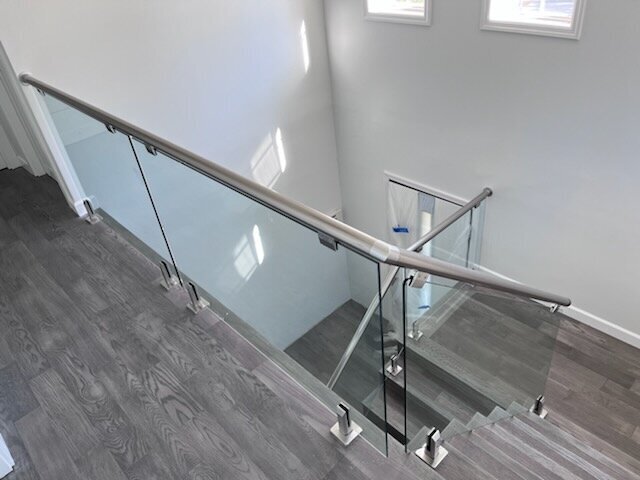
Modern Railing Co's aluminum railing & glass railing systems are available in various styles to complement residential and commercial settings. Main features include:
* Strong and durable construction (weatherproof)
*3/8 & 1/2 inch Tempered Glass
*9/16, 11/16 and 13/16 Laminated Tempered Glass
* Extremely long service life
* Unique finish (anodizing) which fulfills high quality standards (doesn't rust or corrode).
* High resistance to UV radiation (doesn't flake or crack)
* Flexible designs
* Easy maintenance
* All items are in stock
Request a Quote
South Florida GLass & Aluminum Railings
Check out our reviews on Google
About US
(561)672-0717
info@modernrailingco.com
980 North Federal Highway Suite 110
Boca Raton, FL 33432
Shipping Available in the US & Installation in South FLorida.
Contact Us