
Call For estimate
Glass Railings
Black Aluminum Railings
Dark & Light Wood Railings
Aluminum Railings
Call (561)672-0717

Knee Wall Railings
Fascia Mount Railings
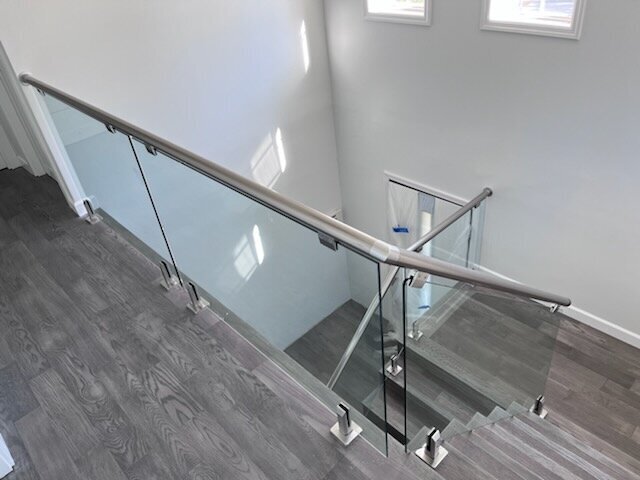
Indoor Stair & Surface Mount Railings
Outdoor Stair & Surface Mount Railings
Handrails
Standoff-Pins Glass Railing Systems
Glass Railing Post Systems

Glass Pool Fence Requirements in Broward County
Planning a glass pool fence for your home in Pompano Beach or anywhere in Broward County? Before an inspector signs off, the barrier has to clear a short list of rules.
A residential glass pool fence in Broward County must stand at least 48 inches tall, leave no opening a young child could slip through, and use a self-closing, self-latching gate, all under Florida's Residential Swimming Pool Safety Act. That is glass pool fence code compliance in Florida at its most basic.
The numbers are the easy part. What catches people off guard is how Broward enforces them, and how living on the coast changes the glass you are allowed to use. Sorting that out now saves you a failed inspection and a second round of permit fees later.
What does Florida's Residential Swimming Pool Safety Act require?
Chapter 515 of the Florida Statutes says every residential pool needs a safety barrier that keeps young children away from the water, and a glass fence qualifies as long as it meets the height, spacing, and gate rules. The law is about drowning prevention, and inspectors hold it to that standard.
It applies to new pools and often kicks back in during a major remodel. Glass earns approval the same way aluminum or mesh does, by removing the gaps and footholds a small child could use to get over or under it.
Gate latch placement and self-closing hardware
How high does a pool fence need to be in Florida?
Does pool fence glass need to be impact rated in Broward County?
Yes. Broward County falls inside the High-Velocity Hurricane Zone, so any exterior glass in a pool fence has to be impact rated and meet local wind-load standards. This is the rule that sets a Broward install apart from one further inland.
Glass and hardware in the HVHZ are expected to carry approval paperwork, often a Florida Product Approval or a Miami-Dade Notice of Acceptance that Broward honors. For frameless glass pool fencing in Broward County, that means panel thickness, anchors, and spigot spacing all get checked against hurricane wind loads. Skip it, and the project can stall at plan review before anyone picks up a drill.
Tempered or laminated glass for a pool barrier
Both are approved safety glazing for pool barriers, so the real question is how each one breaks. In a hurricane zone, that behavior matters more than looks.
Tempered glass is heat-treated to several times normal strength and crumbles into small, dull bits if it fails, with no large shards. Laminated glass bonds two layers around an inner film, so a cracked panel holds together instead of dropping out. Plenty of coastal installs use a laminated-tempered mix to get both qualities at once.
Choosing between frameless and semi-frameless glass
Frameless gives you an open view with almost no visible metal. Semi-frameless adds posts or a top rail for extra rigidity. Both can pass code in Broward County. Waterfront homeowners across South Florida usually lean frameless to keep the line of sight to the water clean.
Your deck, your budget, and how exposed the fence line is to wind will point you toward one or the other. Here is how they compare.

Which setup fits your yard?
The right choice depends on your site, not a blanket rule. Deck surface, wind exposure, sightlines, gate placement, and local approval requirements can all affect which glass fence system makes sense.
For homes in Pompano Beach, the same county standards apply to glass pool fence projects across Pompano Beach, so panel thickness, hardware, spacing, and product approval should be confirmed before work starts.
Once the code details are clear, the decision becomes simpler. Frameless glass pool fence systems are built around these height, spacing, and impact rules, which helps avoid delays during installation and inspection.
Your barrier has to be at least 48 inches high, measured from the ground on the outside of the fence. That four-foot minimum is the same for glass as for any other material.
Height is one of three spacing rules. The gap under the fence cannot top two inches, and no opening anywhere can be wide enough to pass a four-inch ball. A solid glass panel clears the opening rule on its own, but the gap beneath it still gets measured.
What the four-inch rule means for glass panels
For frameless and semi-frameless systems, the measurement that matters is the space beneath each panel and between panels, not the glass face. The sheet itself already blocks the climb-and-slip gaps that trip up railing-style barriers.
Installers handle this by setting panel height and spigot placement so the bottom gap stays under two inches and the seams stay tight. A clean install does as much for compliance as the glass does.
Your gate has to swing outward, away from the pool, then close and latch on its own. A gate someone has to remember to pull shut will fail.
The latch release usually needs to be at least 54 inches above the bottom of the gate, on the pool side. Lower placement is allowed under stricter conditions, with shielding so a child cannot reach through. Self-closing hinges and a tested latch are the first things an inspector checks.
Frameless tends to win on open patios where the view is everything. Semi-frameless earns its place on long, exposed runs that take the brunt of the wind off the water. Neither is the automatic right answer for every yard.
We provide free estimates and service South Florida - Palm Beach County, Broward County and Miami-Dade County. All of our material is available & in stock making, turnaround time currently at 2-3 weeks (subject to change) for installations and for shipping orders within 5 business days in US & abroad.
Modern Railing Co has top quality material, industry experience, dedication to service, make us different than others. We will deliver your expectations!
Modern Railing Co's aluminum railing & glass railing systems are available in various styles to complement residential and commercial settings. Main features include:
* Strong and durable construction (weatherproof)
*3/8 & 1/2 inch Tempered Glass
*9/16, 11/16 and 13/16 Laminated Tempered Glass
* Extremely long service life
* Unique finish (anodizing) which fulfills high quality standards (doesn't rust or corrode).
* High resistance to UV radiation (doesn't flake or crack)
* Flexible designs
* Easy maintenance
* All items are in stock
Request a Quote
South Florida GLass & Aluminum Railings
Check out our reviews on Google
About US
(561)672-0717
info@modernrailingco.com
980 North Federal Highway Suite 110
Boca Raton, FL 33432
Shipping Available in the US & Installation in South FLorida.
Contact Us